Your competitor published a blog post last month. Now ChatGPT cites it when prospects ask about your category. Perplexity links to it. Google AI Overviews feature it above the fold.
You published a better post. Nobody’s AI assistant knows it exists. The difference is not quality. It is structure, specificity, and strategy for ai overviews optimization.
Why Great Content Still Gets Ignored by AI Engines
Content marketers assume authority equals visibility. It does not. Not anymore.
AI engines do not rank pages the way Google does. They extract answers. They look for content that provides a clean, citable response to a specific question. Broad, keyword-optimized guides often fail this test entirely.
The other problem is measurement. Most teams have zero insight into whether AI engines reference their content. They track organic rankings and call it a day. Meanwhile, competitors with weaker domains earn citations because their content was built for extraction.
You cannot win an ai citations game you are not even tracking.
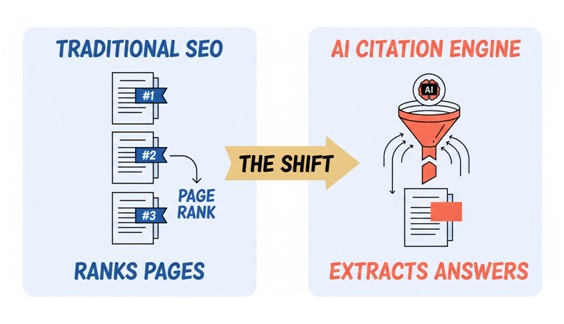
Infographic showing the paradigm shift from traditional SEO ranking to AI citation extraction
What Citation-Worthy Content Actually Requires
Specificity Over Comprehensiveness
AI engines pull the most precise answer available. A page that says “email open rates vary by industry” loses to one that says “B2B SaaS email open rates averaged 21.3% in Q4 2025.” Specific numbers get cited. Generalities get skipped.
Named Expert Attribution
Quotes from named, credentialed experts signal authority to AI retrieval systems. Anonymous insights carry no weight. If your content lacks real people saying specific things, it looks like every other blog post.
Direct-Answer Formatting
Structure content so AI engines can extract clean responses. Short paragraphs. Clear headers that match query intent. Lead sentences that directly answer the question before expanding. A skilled geo agency builds this formatting into every content brief.
Schema Markup and Structured Data
FAQ schema, HowTo schema, and article structured data give AI engines explicit signals about your content’s purpose. Pages without structured data force AI systems to guess. They usually guess wrong.
Freshness and Update Cadence
AI engines deprioritize stale content. Pages updated with current data, recent examples, and timely references earn more citations than evergreen pieces that have not been touched in 18 months.
A Repeatable Process for Earning AI Citations
Identify the exact questions AI engines answer in your space. Run your target queries through ChatGPT, Perplexity, and Google AI Overviews. Document which sources get cited. Note the format, length, and data density of cited content.
Build a citation gap analysis. Compare cited competitor pages against your own. Look for specific differences: do they include proprietary data? Named experts? Cleaner structure? This analysis shows you exactly what to fix.
Restructure existing pages for extraction. Take your highest-authority pages and reformat them. Add direct-answer lead sentences. Insert specific statistics. Include expert quotes with full attribution. This is not a rewrite. It is a surgical upgrade.
Publish original research monthly. One data-backed study per month outperforms ten opinion pieces. Survey your customers. Analyze your platform data. Partner with a geo agency that runs AI-powered workflows to identify which research topics AI engines are actively seeking sources for.
Monitor citations weekly, not quarterly. Set up automated tracking for your brand mentions across ChatGPT, Perplexity, and AI Overviews. When a competitor displaces you, you want to know within days, not months.
The Citation Gap Is Widening Fast
Thirty-eight percent of U.S. adults now use AI tools for search-style queries at least weekly. That number doubles among the 25-44 demographic, which is exactly who most B2B companies need to reach.
Every AI citation your competitor earns reinforces their authority in the model’s training loop. The rich get richer. The absent stay absent. This is not a gradual erosion. It is a compounding disadvantage for brands that delay.
Companies that built chatgpt citation strategy into their content process six months ago now see 40% more qualified inbound from AI-referred traffic. They did not wait for perfect data. They shipped, measured, and iterated.
The window for first-mover advantage in ai overviews optimization is closing. The brands that move now define the cited sources for their category. Everyone else fights for whatever visibility is left.